What the Business Analyst’s 500+ Page Rulebook (BABOK) Actually Taught Me About Work


Table of contents
- Introduction: Beyond the Buzzwords
- 1. You’re Probably a Business Analyst (Even if It’s Not in Your Title)
- 2. It’s All About ‘Why’: The Subtle Dance Between Requirements and Designs
- 3. The Entire Profession Can Be Distilled into Six Core Concepts
- 4. Business Analysis is More About People Than Processes
- Conclusion: A Skill Set, Not Just a Job Title
Introduction: Beyond the Buzzwords
What do product managers, data analysts, management consultants, and process owners have in common? On the surface, they seem like distinct roles in different corners of an organization. Yet, they all share a common, critical function: driving change and creating value. My curiosity about this shared DNA led me to a surprising source: the official, 500-plus-page manual for business analysis.
This manual, A Guide to the Business Analysis Body of Knowledge® (BABOK® Guide), is the globally recognized standard for the profession. But to dismiss it as a job manual for a niche role is to miss its true significance. It is a comprehensive codification of the skills required to successfully drive any strategic change. Hidden within its formal language are the foundational principles of organizational transformation—a kind of “physics of change” that applies universally, regardless of your job title.
After distilling this comprehensive guide, I found four counter-intuitive takeaways that are too valuable to be confined to a single profession. These are not buzzwords or abstract theories, but practical, powerful insights that anyone can use to become more effective in their role, starting tomorrow.
1. You’re Probably a Business Analyst (Even if It’s Not in Your Title)
The first major revelation is that the term “Business Analyst” is widely misunderstood. Most people think of it as a specific, niche job title. The guide, however, offers a definition so broad that it likely includes you and many of your colleagues.
The official standard defines a business analyst not by their title, but by the work they perform.
A business analyst is any person who performs business analysis tasks described in the BABOK® Guide, no matter their job title or organizational role.
To illustrate this point, the guide lists a wide range of common job titles for people who perform business analysis. Chances are, you’ll recognize a few:
- Business architect
- Business systems analyst
- Data analyst
- Enterprise analyst
- Management consultant
- Process analyst
- Product manager
- Product owner
- Requirements engineer
- Systems analyst
This insight is crucial because it reframes business analysis from a rigid job function into a set of vital skills and activities. If your work involves understanding problems, devising strategies, analyzing needs, or facilitating stakeholder collaboration, you are performing business analysis. It’s a skill set, not just a job title.
2. It’s All About ‘Why’: The Subtle Dance Between Requirements and Designs
Many projects get bogged down when teams and stakeholders jump straight to building a solution (the “how”) without a crystal-clear understanding of the underlying need (the “why”). This often results in features that are technically sound but fail to deliver real value.
The BABOK® Guide addresses this head-on by drawing a simple but powerful distinction between requirements and designs.
- Requirements are focused on the need. They represent a usable articulation of a problem or opportunity.
- Designs are focused on the solution. They represent a usable depiction of a specific way to satisfy the need.
The line between them can be subtle, but the shift in focus is critical. One person’s requirement often becomes the basis for another person’s design. The guide provides clear examples to make this distinction tangible:
| Requirement (The Need) | Design (The Solution) |
| View six months sales data across multiple organizational units in a single view. | A sketch of a dashboard. |
| Record and access a medical patient’s history. | Screen mock-up showing specific data fields. |
The analyst acts as the crucial link, perpetually tethering the proposed solution (the Design) back to the foundational problem (the Requirement). By continuously asking “Why?”, they prevent “solutioneering”—building features without a clear purpose—and ensure every ounce of effort serves a validated business need, thereby protecting the project’s ROI.
3. The Entire Profession Can Be Distilled into Six Core Concepts
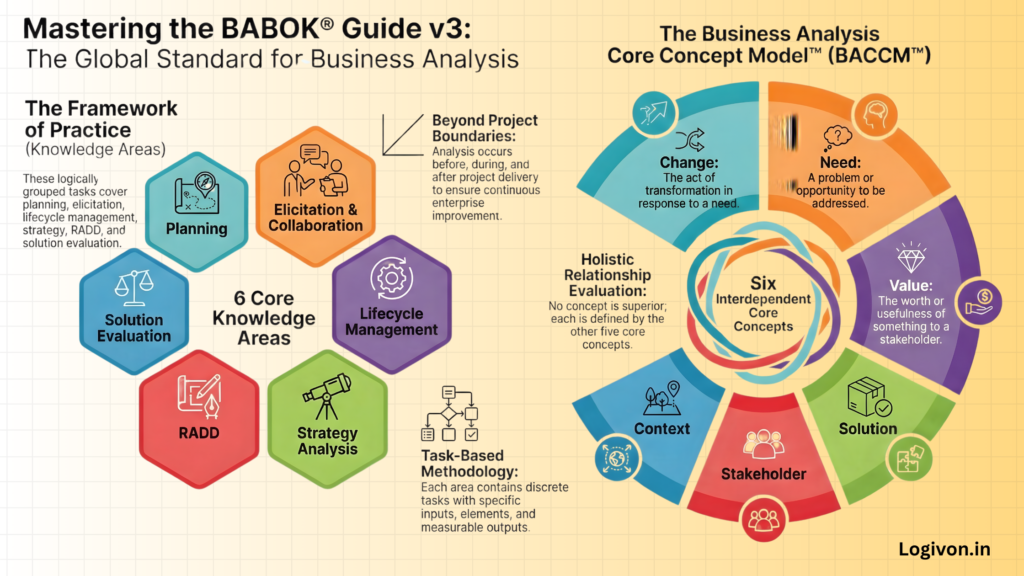
For a discipline that spans hundreds of pages of official guidance, business analysis is grounded in a surprisingly simple and elegant framework: The Business Analysis Core Concept Model™ (BACCM™). This model asserts that the entire profession, regardless of industry or methodology, can be understood through the interrelationship of six core concepts.
These six concepts provide a complete mental checklist for thinking through any change initiative:
- Change: The act of transformation in response to a need.
- Need: A problem or opportunity to be addressed.
- Solution: A specific way of satisfying one or more needs in a context.
- Stakeholder: A group or individual with a relationship to the change, the need, or the solution.
- Value: The worth, importance, or usefulness of something to a stakeholder within a context.
- Context: The circumstances that influence, are influenced by, and provide understanding of the change.
The true power of this model lies in its interconnectedness; as the guide states, “Each core concept is defined by the other five core concepts and cannot be fully understood until all the concepts are understood.” You cannot truly define Value without understanding the Stakeholder who perceives it and the Context they are in. You cannot define a Solution without the Need it addresses. This principle of mutual definition makes the model a powerful tool for holistic thinking, ensuring no critical angle is missed when planning and executing change.
4. Business Analysis is More About People Than Processes
Perhaps the most surprising revelation in the BABOK® Guide is its relentless focus on human dynamics. The stereotype of an analyst often involves a person working in isolation with data and documents. The guide, however, argues that successful analysis is fundamentally a human-centric and collaborative endeavor.
By codifying Elicitation and Collaboration as a core Knowledge Area and dedicating a full chapter to Underlying Competencies, the guide elevates skills like communication and interaction from “soft skills” into a core, technical discipline. These are not optional extras; they are mission-critical. Key competencies include:
- Behavioural Characteristics
- Communication Skills
- Interaction Skills
The guide’s emphasis on Manage Stakeholder Collaboration is explicit. It directly warns of the dangers that arise from poor stakeholder relationships, which can lead to “failure to provide quality information” and “resistance to change.” The message is clear: without effective collaboration and strong relationships, even the most rigorous analysis is likely to fail. The practice is less about perfecting a process and more about building relationships, managing diverse perspectives, and guiding groups of people toward a common goal.
Conclusion: A Skill Set, Not Just a Job Title
The BABOK® Guide proves that business analysis is not a department, but a foundational business competency. It is the structured practice of translating strategy into execution—a skill set that is now essential for anyone tasked with creating lasting value in a complex organization. The ability to distinguish need from solution, simplify complexity into core concepts, and foster human collaboration is critical for success in any modern profession.
By embracing these principles, we can all become more effective agents of change. Looking at your own work, which of these core ideas—clarifying the ‘why’, managing stakeholder needs, or simplifying complexity—could you apply tomorrow to make a bigger impact?
Responses